The English Montreal School Board is deeply disappointed with the Supreme Court of Canada’s decision to uphold (by a narrow 4 to 3 margin) the constitutionality of Bill 21
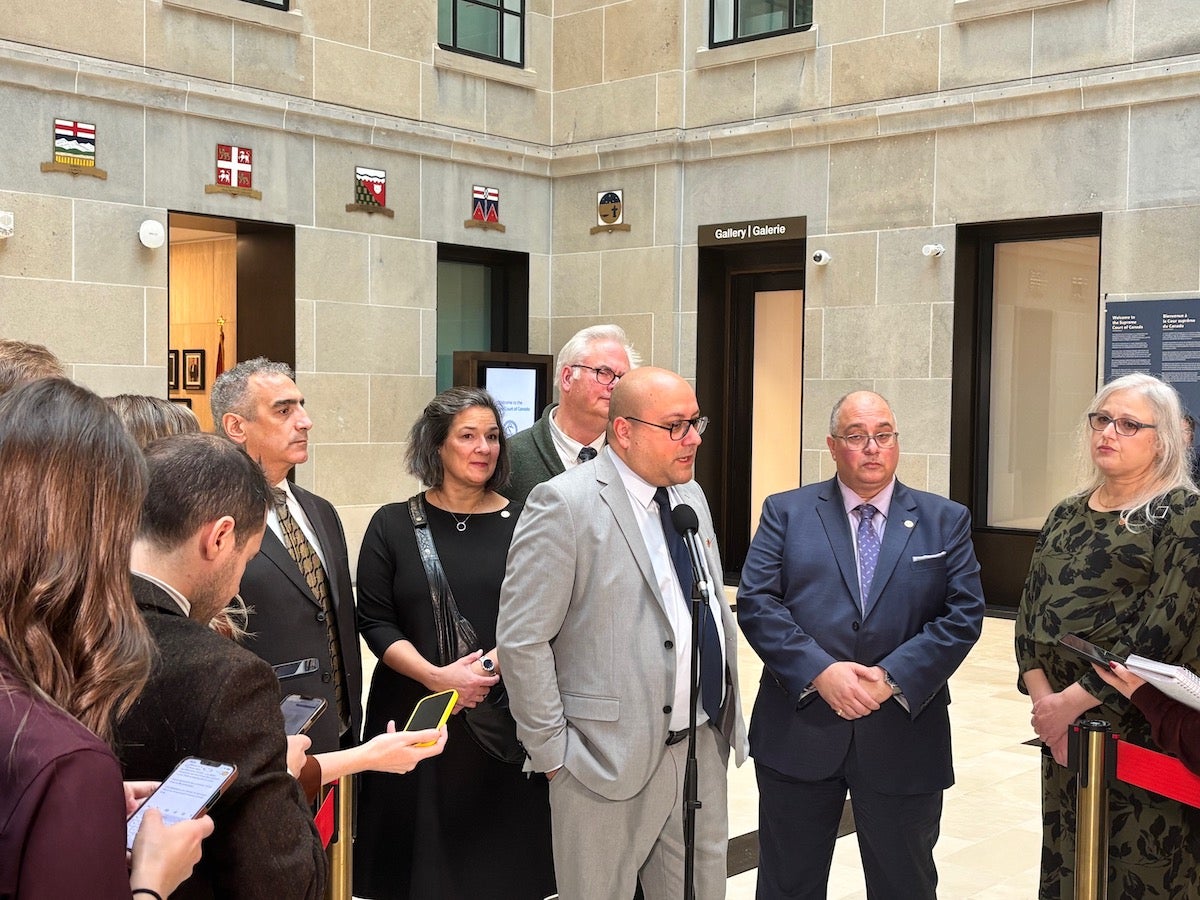
The English Montreal School Board (EMSB) is deeply disappointed to have lost its appeal by the narrowest of margins.
Three of the only seven judges who heard the appeal would have allowed the EMSB’s appeal and struck down Bill 21 on the basis that it impermissibly infringes section 28 of the Canadian Charter of Rights and Freedoms, which guarantees the rights and freedoms in the Canadian Charter equally to male and female persons.
Two of the seven judges would have found that Bill 21 impermissibly infringes section 23 of the Charter, which guarantees, to Quebec’s anglophone communities and to the rest of Canada’s Francophone and Acadian communities, the right to manage and control its primary and secondary schools, with one of the seven judges not pronouncing herself on section 23 at all as a result of having found that Bill 21 breaches section 28.
The EMSB notes that only seven of nine judges heard the appeal; neither Justice Jamal nor Justice Moreau were on the panel that heard the case.
EMSB takes some solace in the fact that four judges agreed that courts can issue declarations of invalidity even when the notwithstanding clause is invoked. Such declarations play an important role in holding governments accountable as the resort to the notwithstanding clause must be renewed every 5 years. Here, a majority of four judges (out of seven) of the Supreme Court found that Bill 21 is discriminatory, in particular against Muslim women. These conclusions from a majority of the Court validate the EMSB’s efforts: EMSB has argued from the beginning of this challenge that Bill 21 discriminates against its Muslim teachers.
“We maintain that Bill 21 conflicts with our values, our mission and with those of all Quebecers as expressed in the Quebec Charter of Human Rights and Freedoms,” said EMSB Chair Joe Ortona. “Its very adoption was contrary to our societal goal of promoting our peaceful co-existence in a pluralistic Québec.”
As a reminder, the EMSB challenged Bill 21 in 2019 in the Québec Superior Court. Bill 21 bars public-school teachers, government lawyers, judges and police officers from wearing religious symbols while at work.
“We value the diversity of our students and staff and respect their personal and religious rights which are guaranteed both by the Canadian and Quebec Charters of Rights and Freedoms,” said Mr. Ortona. “This legislation runs contrary to what we teach with regard to respect for individual rights and religious freedoms.”
Mr. Ortona added that rather than promoting gender equality, Bill 21 has the opposite effect. “Due to the preponderance of women working in Quebec schools, the law has a disproportionate effect on them, particularly well-educated Muslim women with university teaching degrees whose role in public life is restricted,” he said. As Justice Martin held, “Muslim women are overwhelmingly the ones who have been denied employment or been forced to remove their religious symbols”.
The EMSB will continue analyzing today’s complex and very divided judgment over the next months.
About the English Montreal School Board
With more than 33,000 students, the English Montreal School Board (EMSB) is the largest English public school board in Quebec. Established on July 1, 1998, when the province created new boards along linguistic lines. Our network consists of 77 schools and centres. For more details, visit the EMSB website at www.emsb.qc.ca.






We offer training on job-related skills, upgrading of certifications, customized training packages in vocational training, and much more.
AEVS Affordable Luxury
Did you know two of our vocational centres offer premium services at a discount?
Dine at PiusSalon & Aesthetics